The iVISION project, a step forward in restoring vision
20/08/2026
02/03/2026
Many problems with concentration, poor academic performance, or constant fatigue have their origin in undetected poor visual health; having one’s eyesight checked in time is key to guaranteeing children’s learning and future, especially when they live in vulnerable situations.
During childhood, good vision is essential to keep up at school, correctly interpret the blackboard, read fluently, and participate actively in the classroom. When undetected visual defects exist, problems with concentration, resistance to reading, headaches, or low academic performance frequently appear—often mistaken for disinterest or lack of effort. Detecting and treating these conditions in time not only improves eyesight, but also directly impacts self-esteem, motivation, and the ability to relate to one’s surroundings—essential pillars for healthy academic and social development.
When a boy or girl grows up in a vulnerable situation, access to ophthalmological check-ups and glasses can become an unattainable luxury, worsening already existing social inequalities. The Barraquer Foundation understands that visual health is a right and works to ensure that no minor is left behind for economic reasons, bringing specialized and free care to the most vulnerable groups and collaborating with leading social organizations. Seeing well is not only a medical matter: it is a condition that allows children to participate on equal terms at school, build their life project, and break the cycle of inherited inequality. In short, seeing well also means growing up in equality.
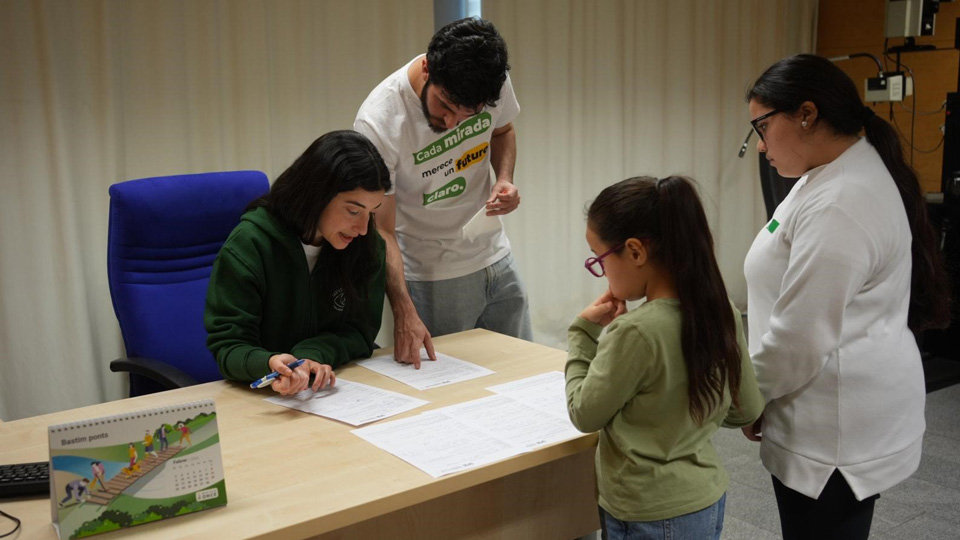
With this vision, the initiative “Cada mirada merece un futuro claro” was created, jointly promoted by the Barraquer Foundation, the ONCE Foundation, and the ONCE Foundation for Low Vision (FOBV), to offer free vision check-ups and the donation of glasses to more than 300 children at risk of exclusion during the first half of the year. Between February and June, the program travels through six autonomous communities—Catalonia, Madrid, the Valencian Community, the Region of Murcia, Andalusia, and the Canary Islands—with sessions held in ONCE centers where teams of optometrists and ophthalmologists carry out comprehensive evaluations, prescribe glasses, and, if necessary, refer patients for specialized treatment. The objective is clearly social: to prevent vision problems that may affect learning, autonomy, and well-being, reducing barriers so that these minors can have a more limitation-free academic and personal future.
Thanks to initiatives such as “Cada mirada merece un futuro claro,” the Barraquer Foundation reinforces its commitment to a childhood that deserves to grow up with the same opportunities, regardless of social or economic context. Every free check-up, every pair of adapted glasses, and every early diagnosis is an investment in the learning, emotional health, and future of these children—and one more step toward a society in which visual health is not a privilege, but an effective right for everyone.