Key points to distinguish between retinal detachment and vitreous detachment
23/10/2026
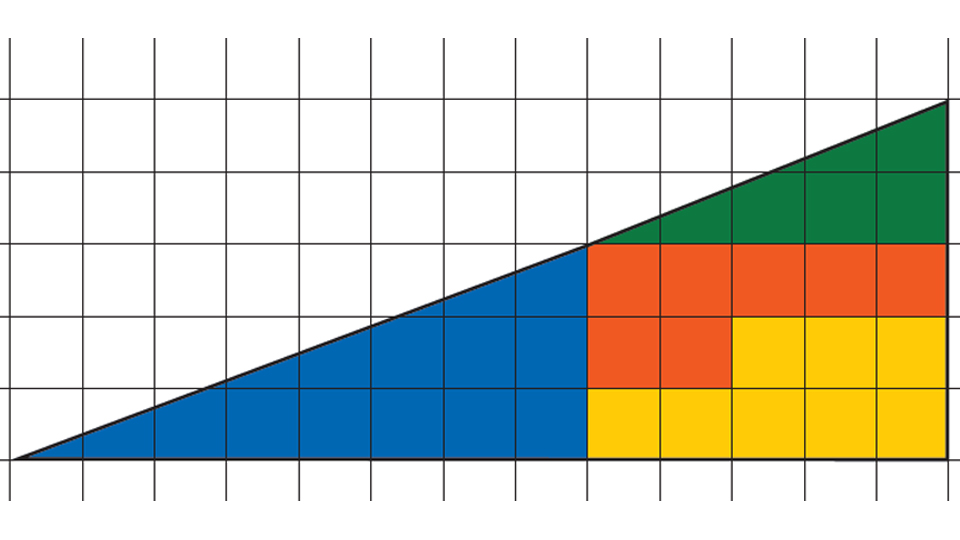

At a time such as the present, resonant with ominous anniversaries, it is also worth remembering the illuminating figure of the popular science writer and philosopher Martin Gardner (1914–2010). For decades, he delighted and educated us through his “Mathematical Games” column in the best-known popular science magazine, Scientific American—published in Spanish as Investigación y Ciencia.
In 1956, Gardner popularised a puzzle devised a few years earlier by Paul Curry, a New Yorker with an interest in magic. It consists of a right-angled triangle with perpendicular sides measuring 13 and 5 units. Two triangles, with side ratios of 8:3 and 5:2, are cut from it. This leaves a rectangular section measuring 3 × 5 units (area = 15), which can be divided into two L-shaped pieces with areas of 7 and 8 units, or squares.
When we reconstruct the puzzle by changing the positions of the triangles, a rectangle measuring 2 × 8 units (area = 16) remains to be filled. When the two L-shaped pieces, which have a combined area of 15 units, are inserted, we discover that one square remains unfilled.
The key to this puzzle is that the proportions of the small triangles are different—8:3 and 5:2—and, therefore, so are the slopes of their hypotenuses. The combined hypotenuse is very slightly curved, almost imperceptibly—by around 1/28 of a unit—outwards or inwards in the different configurations.
On closer inspection, the point where the triangles meet coincides with a grid intersection at (8, 3), whereas in the lower configuration the purple triangle extends slightly beyond it. The upper vertex of the green triangle coincides with the intersection at (5, 2) in the lower configuration, but in the upper one the hypotenuse of the purple triangle passes slightly below this point.
Similar geometric dissections involving a change in area had already been described by Edmé G. Guyot in 1769 and William Hooper in 1794, and even by Sebastiano Serlio in the 16th century. Gardner and others developed versions involving non-orthogonal polygons, such as trapezoids, or other combinations of triangles and polygons (Fig. 3). It can be demonstrated that the difference will be exactly one unit of area when the numbers used in the dissection belong to the Fibonacci sequence (1, 1, 2, 3, 5, 8, 13, 21…).
The missing-area paradox also reveals that the idea of the “parts of a whole”—the pieces of a puzzle, which by definition remain identical to themselves—takes precedence in our visual perception over a direct estimation of slopes or alignments.
Prof. Rafael I. Barraquer, Medical Director of the Barraquer Ophthalmology Centre