Key points to distinguish between retinal detachment and vitreous detachment
23/10/2026


Fix your gaze on the red dot at the centre of this figure. After a while, the blue circle gradually “dissolves” and is replaced by the white colour of the background. This phenomenon of visual fading or filling-in reveals another aspect of our perception.

One of the most studied phenomena in visual perception is the so-called reification: the process by which our perception “creates” images not only from the information reaching the eyes—often fragmentary—but by completing it on the basis of memory or the rules of visual “logic”. This is demonstrated by “illusory” figures such as the Kanizsa triangle and others in which we perceive objects that are not actually outlined, even three-dimensional or complex ones, with the help of only a few cues or indications.
Visual filling-in is one of the mechanisms that completes the parts of an object that remain hidden and, for example, prevents us from being aware of our physiological blind spot—at the position where the optic disc is located—or of other scotomas.
The fading of the ring in the first figure is known as the Troxler effect and is the basis of very popular internet illusions such as the “lilac chaser” (we cannot reproduce it here as it is a moving figure, but see, for example: https://es.wikipedia.org/wiki/Perseguidor_del_lila).
There are static versions such as the following, created by Professor Kitaoka:
Troxler fading (or Troxler bleaching) is only one example of visual filling-in. If we fix our gaze (preferably covering one eye) on the central point in the disc above, the entire grey area surrounding it will also gradually “disappear”; alternatively, it may be the central spot itself that does so (in the green disc).

This phenomenon has been explained at a basic physiological level as the result of adaptation or “fatigue” of retinal neurones in response to a constant and unmoving stimulus, which therefore tends to fade. However, this does not explain why it is replaced by the colour of the background. Other theories invoke mechanisms operating in the cerebral cortex, whether at a low level (isomorphic filling-in) or at a higher level (symbolic filling-in), a question that remains open to debate.
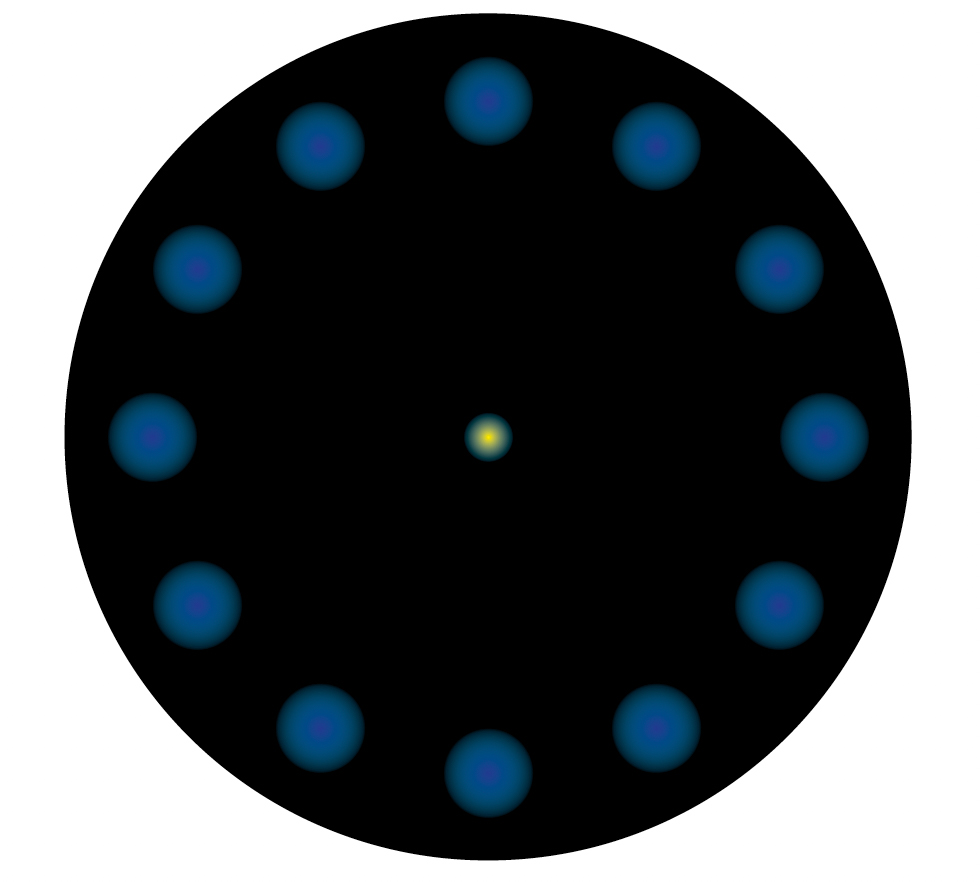
In any case, there is consensus that the apparent colour and brightness of a surface depend on the perception of its edges. These may act either as barriers to the physical “diffusion” of colour, or serve as reference points for a representation of oriented features to which the chromatic element is only subsequently added as an attribute of the object. The lack of clearly defined edges is what allows fading and filling-in by the background colour. But let us recall our ability to create imaginary edges such as those in the Kanizsa triangle, which in turn produce the illusion of different brightness within the area they enclose.
Professor Rafael I. Barraquer, medical director of the Barraquer Ophthalmology Centre