Side effects of glaucoma eye drops: what is normal and what isn't
28/10/2026
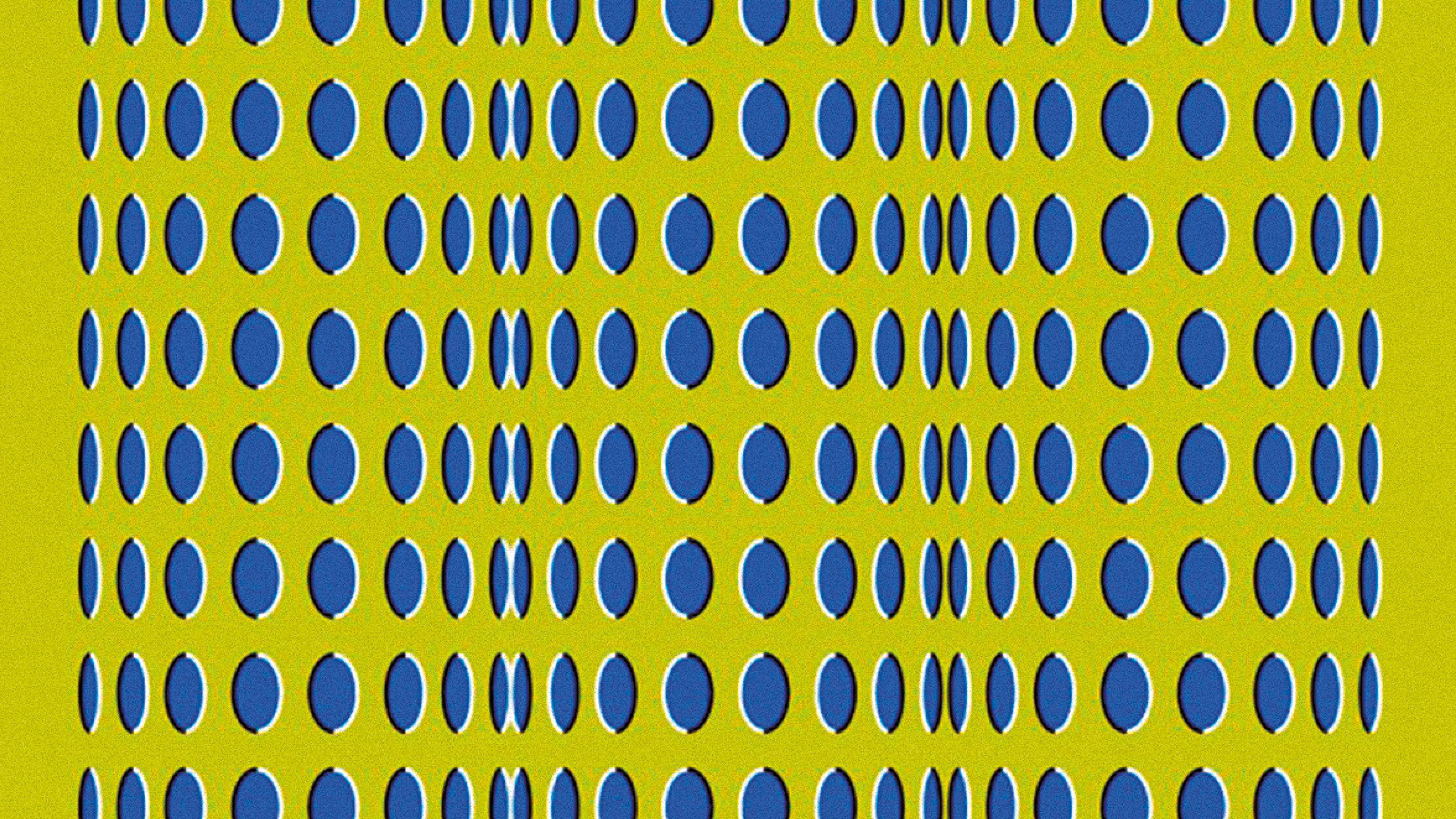

In today's audiovisual world, we are increasingly exposed to a mixture of still images and moving videos. We can usually distinguish between the two without any difficulty. But are we sure this will always be the case? Motion illusions challenge the boundary between what is static and what is moving.
If we allow our gaze to wander over the rosettes or "snakes" in the figure, they appear to rotate, challenging our conviction that they are a still image. The effect ceases if we fix our gaze on one particular centre. This illusion, created in 2003 by Akiyoshi Kitaoka, from Ritsumeikan University in Kyoto, has venerable predecessors dating back to Hermann von Helmholtz, the renowned 19th-century physicist and inventor of the ophthalmoscope.
Other static images can also create the illusion of movement, whether by moving the figure or the eyes, by moving it closer or further away, or simply through the tiny eye movements that occur during fixation.
In the case of the Ouchi figure, the explanation lies in the compensatory mechanisms that normally stabilise the perceived image despite eye movements. The presence of two opposing patterns (vertical and horizontal) creates a conflict between the process that computes the local direction of movement and the one that integrates this information across space and determines whether the different areas correspond to separate objects or different planes.
However, Kitaoka's snakes appear to rotate without us moving either the paper or our eyes at all. This is thought to be due to a particular sequential arrangement of luminance values—an effect that can also be produced using shades of grey, although sequences of colours enhance it.
Because transitions with greater contrast have a shorter perceptual latency than those with lower contrast, a "wavy" sequence of tones creates the sensation of a preferred direction. Depending on the arrangement of the coloured patches, illusions of circular or cylindrical rotation, lateral displacement, undulations, pulsations, expansion or contraction, and so on can be created.
Motion illusions are powerful tools for unravelling how visual perception works, as they test the mechanisms that give us remarkable abilities—although we are rarely aware of them—such as computing the trajectory of a moving object (allowing us, for example, to catch a ball) or recognising an object as stationary despite the constant movements of our eyes.
Professor Rafael I. Barraquer, Medical Director of Barraquer Ophthalmology Centre