Unlawful use and manipulation of doctor Elena Barraquer's image
22/07/2026
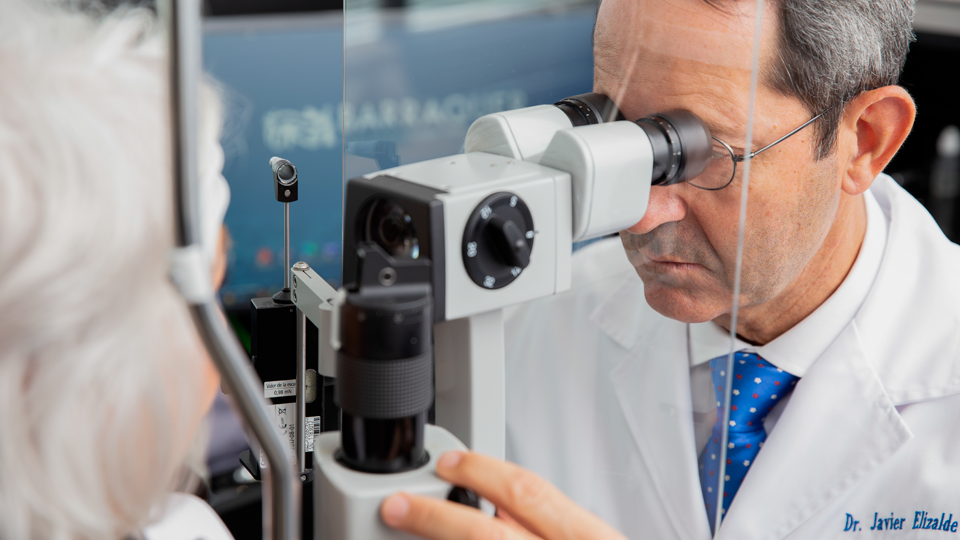

One of the first symptoms is the sudden appearance of floaters.
Patients describe them as:
It is normal to notice floaters, also known as myodesopsia, as we get older. What is concerning is a sudden and significant increase.
This increase is usually caused by liquefaction of the vitreous gel that fills the eyeball. The vitreous becomes more mobile and, because of its attachments to the retina, may cause a retinal tear, which can precede a detachment.
Another characteristic symptom is flashes of light, known as photopsia.
They are described as:
They are not imaginary. They occur when the vitreous pulls on the retina and mechanically stimulates the photoreceptor cells.
This is a warning sign of active traction.
Once the detachment is present, patients may notice:
This symptom indicates that part of the retina has separated and is no longer functioning properly. This situation requires prompt treatment.
The further the detachment progresses, the greater the risk that the macula—the central area responsible for detailed vision—will be affected.
If the detachment reaches the macula, central vision deteriorates rapidly.
The patient may notice:
In these cases, the visual prognosis following surgery is poorer because the light-sensitive cells of the macula have already been affected.
The retina has no pain receptors. Retinal detachment can therefore progress without causing discomfort, which may sometimes delay seeking medical advice.
The absence of pain does not make the condition less serious. In retinal disease, this silence can be misleading.
Retinal detachment is more common in:
In these cases, any sudden change in vision should be assessed by a retinal specialist.
Seek medical attention promptly if you suddenly experience:
An appointment with an ophthalmologist should not be delayed.
Retinal detachment is a time-critical ophthalmic emergency. Detecting it at an early stage, when there is only a retinal tear, may allow prompt laser treatment. If the retina has already detached, surgery is required.
At Barraquer Ophthalmology Centre, we have a 24-hour eye emergency service equipped to assess and treat any of these cases immediately.
Retinal detachment usually begins with subtle but highly characteristic signs: sudden floaters, flashes of light or a shadow that does not disappear.
Recognising these signs and acting quickly can make the difference between preserving vision and being left with permanent visual impairment.
Dr Javier Elizalde, ophthalmologist at Barraquer Ophthalmology Centre